
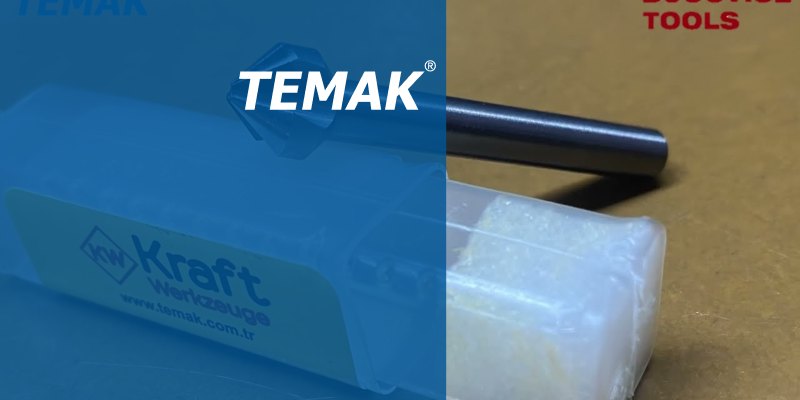
Widely used in machining and assembly, countersinks are special cutting tools used to seat screw and bolt heads flush with the surface at hole entries, remove burrs and chamfer part edges.
Watch Temak Teknik’s information video on countersink types, angle options and application details below:
Main Functions of Countersinks
- Preparing Screw Head Seats: Ensures countersunk-head bolts or screws sit fully flush without protruding from the part surface.
- Deburring and Pre-Hole Enlargement: Removes burrs formed at the hole entry after drilling, producing a smooth surface.
- Chamfering: Chamfers part corners and hole edges at specific angles to make assembly easier.
Countersink Types and Angle Selection
1. Countersinks by Cutting Angle
- 90° Countersinks: The most widely used standard type in the industry. Ideal for countersunk bolt seats to DIN 7991 and ISO 10642 and for deburring.
- 60° Countersinks: Preferred for opening centre hole entries and special chamfering operations.
- 82° and 100° / 120° Countersinks: Generally used in aerospace, medical and special machine building to create seats for different screw standards.
2. By Design Type
- 3-Flute (Multi-Flute) Countersinks with Cylindrical Shank: This widely used design distributes the cutting force evenly across three flutes, delivering a vibration-free, smooth surface finish.
- Cross-Hole Countersinks (Deburring Countersinks): The transverse hole in the conical body draws the chips inwards and evacuates them. They cut cleanly without leaving burrs, especially in soft metals (aluminium, brass) and plastics.
- Fixed-Pilot Counterbores/Countersinks: The cylindrical pilot at the front keeps the tool exactly on the hole axis, so that cylindrical or conical head seats (e.g. socket head cap screw counterbores) are produced without misalignment.
Material and Coating Options
- HSS and HSS-Co (5% Cobalt): The common standard solution for general engineering steels, castings and cast iron. Cobalt-alloyed versions offer greater resistance to heat and wear.
- Carbide Countersinks: Deliver long tool life at high speeds in high-hardness materials (hardened steels, stainless steel etc.) and on CNC machines in series production.
- TiN (Titanium Nitride) Coating: Reduces friction, improves lubricity and significantly increases tool life.
Usage and Application Recommendations
- Speed and Feed: In countersinking operations, high spindle speeds and fast feeds can cause vibration (chatter marks). It is therefore recommended to work at low speed with steady, controlled pressure.
- Axial Centring: Exact alignment of the countersink with the hole axis is critical for balanced load distribution and a smooth surface finish.