
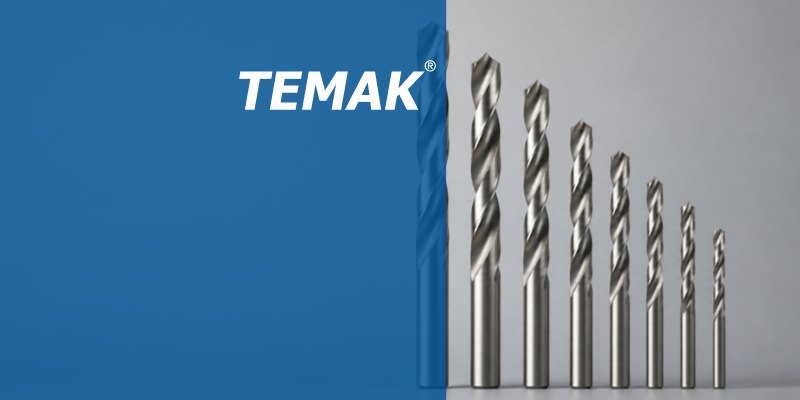
Around 33% of the work carried out in machining processes consists of drilling operations. In such a frequently repeated operation, choosing the right drill bit extends tool life, improves surface finish and lowers manufacturing costs. One of the indispensable tools of any workshop, HSS (High-Speed Steel) drills are among the most widely used drilling tools thanks to their ability to be reused after regrinding.
In this article, guided by Temak Teknik, we examine the types of HSS drills, their helix angles, the importance of cobalt content and coating technologies.
1. Point and Helix Angles by Material (Types N, H, W)
The point angles and helix (flute) angles of drills vary according to the hardness, chip formation and brittleness of the material to be machined:
-
Type N (Standard Drills)
- Point Angle: Usually around 118°.
- Helix Angle: Between 18° and 30°.
- Generally preferred for drilling general-purpose steels and standard materials. For hard and brittle materials, the point angle can be increased to 135° – 140° to enlarge the contact surface.
-
Type H Drills
- Helix Angle: Features a lower helix angle of around 10° – 15°.
- Offers greater resistance when drilling hard, hardened or brittle materials.
-
Type W Drills
- Helix Angle: Features a steeper helix angle of between 35° and 40°.
- Used to evacuate chips quickly in soft materials such as aluminium, brass and plastics, or in materials where chips must be cleared easily.
2. Advantages of HSS-Co (Cobalt) Drills
Standard HSS drills dull quickly in materials that generate high heat during machining and tend to work-harden, such as stainless steels in particular.
- Cobalt Content: HSS-Co drills contain between 6% and 8% cobalt (Co) alloy.
- Heat and Wear Resistance: The cobalt content increases the drill’s strength at high temperatures and improves its wear resistance.
- Application: In stainless steels, heat-resistant steels and difficult alloys, using HSS-Co significantly extends tool life.
3. Coated HSS Drills and Performance
Special surface coating technologies (for example zirconium coating) are used to improve the performance of HSS drills:
- Reduced Friction: The coating minimises friction at the cutting interface between the drill and the material.
- Surface Finish: Ensures a smooth finish on the inner surface of the hole.
- Longer Tool Life: Because it prevents heat build-up and delays wear, it allows more and deeper holes to be drilled in a single run.
In summary: Rather than using the same drill for every material in machining processes, selecting an HSS drill with the helix angle and coating suited to the material type, hardness and operating conditions will increase your manufacturing efficiency.